
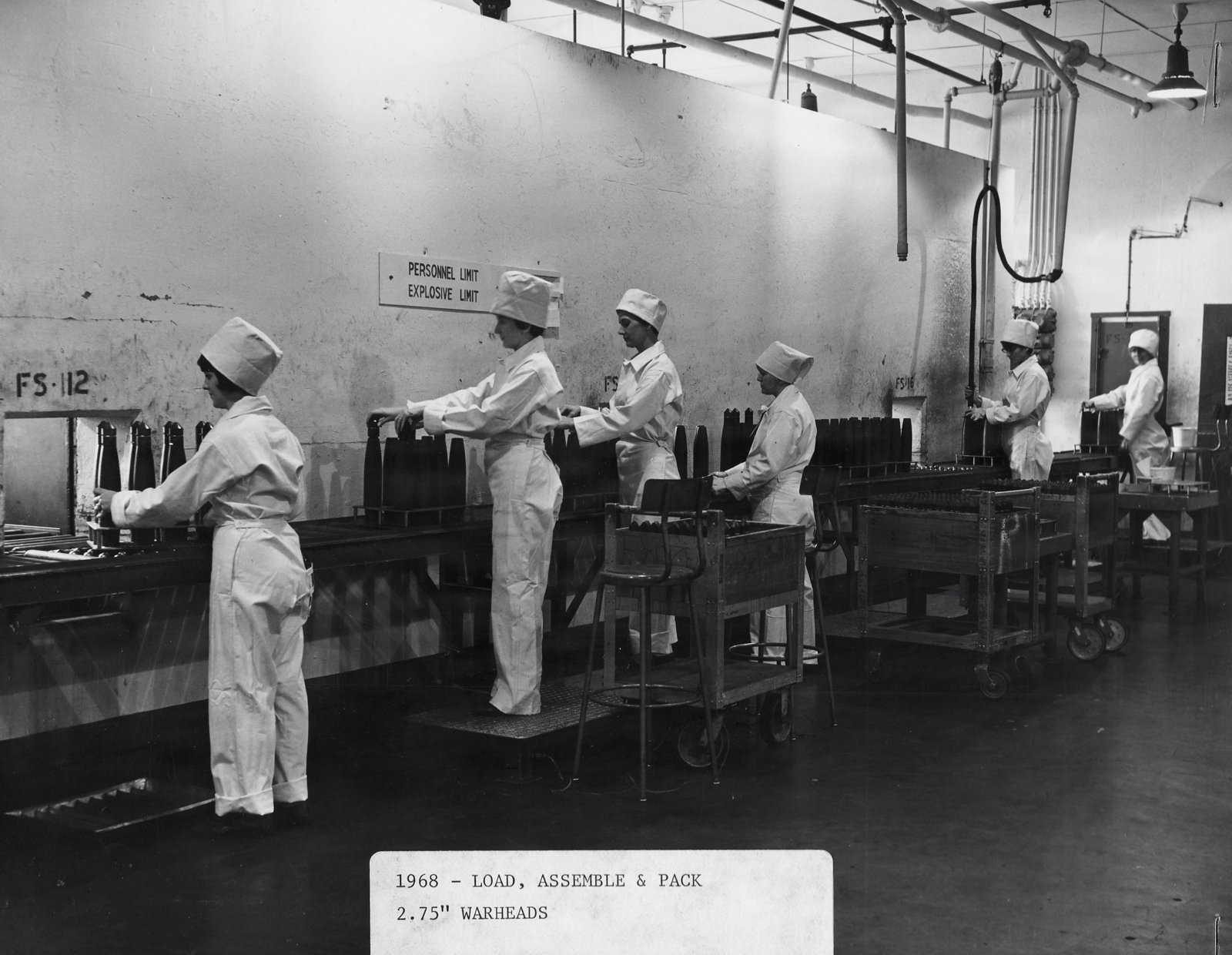
Photo by Dori Whipple, DVIDS. Illustrative image: A 1968 photograph shows workers loading, assembling and packing 2.75-inch warheads at Crane Army Ammunition Activity.
By Steven Smith
France's armed forces minister, Catherine Vautrin, used her speech opening the Euronaval show in Paris to announce new orders of Aster and Exocet missiles and to tie them to a 2027 draft defense budget of 63.4 billion euros, according to the French Ministry of the Armed Forces. The ministry's account says the missile orders are in line with the country's military programming law. It gives no quantities, no contract values and no delivery dates for either missile.
Aster is the family of surface-to-air interceptors carried by French frigates, and Exocet is the anti-ship missile. The ministry's write-up of the speech lists the orders alongside the other naval spending the draft budget is meant to carry: renewal of the nuclear attack submarines, frigates and support ships, and preparation of the future aircraft carrier and the third-generation ballistic missile submarines, known as SNLE 3G. The minister also announced a ramp-up in naval drones with a new program starting in 2027, the ministry says.
The budget figure is a proposal, not an appropriation. The draft 2027 budget provides for defense spending of 63.4 billion euros, an increase of 6.5 billion euros over 2026, the ministry reports, and Breaking Defense carries the minister's own framing of it in English: "The draft budget I am presenting to parliament provides for defense spending to reach €63.4 billion in the 2027 financial year. That is €6.5 billion more than in 2026. This is historic," Vautrin said, in Breaking Defense's rendering. The draft was presented to the National Assembly and the Senate in October and has not been adopted, Breaking Defense reports, with a vote scheduled this month.
The naval drone money is the least defined piece. Breaking Defense, citing the French defense procurement agency DGA, reports that the naval drone initiative unveiled earlier this year is structured in three categories: tactical drones for escort and protection, endurance drones for intelligence and surveillance, and specialized action drones that include remotely operated naval munitions. The total budget for those acquisitions has not been disclosed, Breaking Defense says. The minister also pointed to orders the DGA placed over the summer for surface and underwater drones under the future mine countermeasures program SLAM-F, which Breaking Defense puts at a dozen systems. The procurement agency said those uncrewed mine warfare systems are needed to guarantee freedom of navigation in the current geopolitical context, according to Breaking Defense.
The ministry's account adds a step Breaking Defense does not mention: a naval drone pact signed later the same morning, which the ministry says is meant to bring the armed forces, the DGA and industry closer together. It does not name the signatories or describe what the pact commits anyone to.
The industrial message was the one Vautrin put most weight on. The ministry says she saluted a French naval sector of more than 770 companies and 59,000 direct jobs and called on manufacturers to accelerate both innovation and production, arguing for fewer external dependencies and closer partnerships with Belgium, Greece, the Netherlands and Sweden. In Breaking Defense's English rendering: "Our first weapon is our ability to manufacture as Europeans. That is how we will become stronger," she said. The ministry's French text carries the same line, and both versions record her citing the Swedish partnership on missiles, aviation and naval capabilities and the Belgian and Dutch cooperation on new mine warfare vessels.
The ministry also records the sentence that frames the whole speech, which in translation reads that France has moved from a logic of repair to a logic of rearmament. Breaking Defense leads instead with the minister's line that France intends to be feared in order to remain free, and notes that President Emmanuel Macron used similar language in his March address on nuclear strategy, when he announced an increase in the country's nuclear warhead stockpile.
For a munitions reader the announcement is a direction, not yet a contract. The missile orders are stated as placed, but neither the ministry nor Breaking Defense reports how many Aster or Exocet rounds, which variants, or at what price, and the drone program's budget is undisclosed. What is on the record is the draft budget's top line, the increase over 2026, and the minister's commitment to buy European.
What to watch next is the parliamentary vote on the 2027 budget this month, which decides whether the 63.4 billion euro figure survives intact; any DGA or MBDA announcement that puts quantities and a value on the Aster and Exocet orders; and the first contract notices under the 2027 naval drone program, which would show whether the three-category structure Breaking Defense describes turns into funded lines.
Leave a Reply