
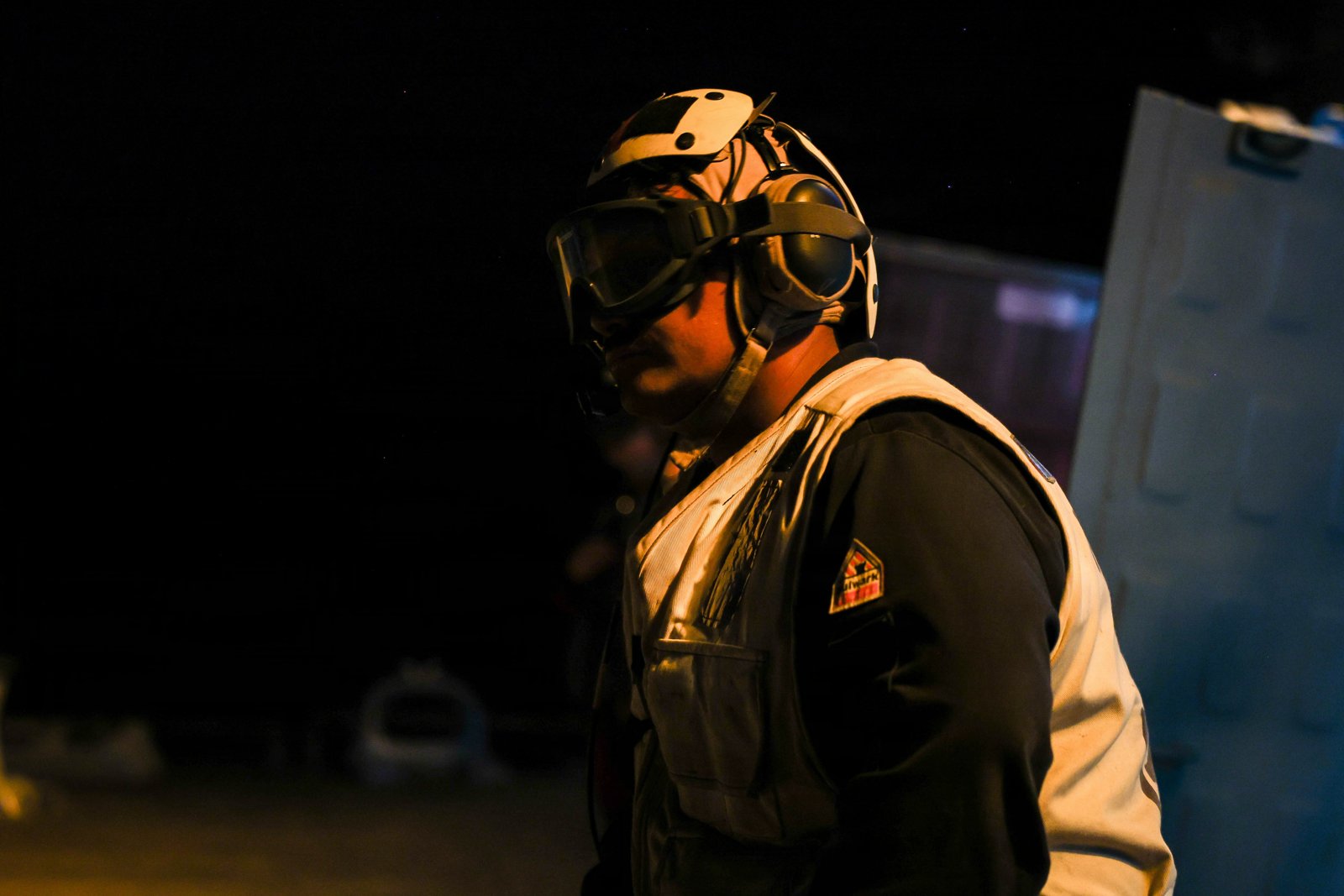
Photo by NAVCENT Public Affairs, DVIDS. Illustrative image: A U.S. Navy sailor oversees flight operations on the flight deck of the Arleigh Burke-class guided-missile destroyer USS Carl M. Levin (DDG 120), deployed to the U.S. 5th Fleet area of operations.
By Steven Smith
The European Commission is expected to choose by the end of November between two rival consortia to carry Europe's hypersonic interceptor into a second development phase, Breaking Defense reports. The choice is between HYDEF, the Hypersonic Interceptor Defence program led by Spanish Missile Systems with Diehl Defence as technical coordinator, and HYDIS, the Hypersonic Defence Interceptor System effort coordinated by MBDA. Only one continues under the Endo-Atmospheric Interceptor program, or EATMI, and Breaking Defense puts the deadline at Nov. 30.
Money on the table is a pledge, not an award. Breaking Defense reports the European Defence Fund, the EU's instrument for co-funding defense research and development, has pledged 100 million euros, about 112 million dollars, for the second phase. Defense News reported in July that the fund's 2026 work program sets that sum aside for an endo-atmospheric interceptor and that only one of the two proposals will be funded.
More is expected from whichever team wins. Lionel Mazenq, MBDA's vice president for incubator programs, told reporters at the Euronaval show in Paris that 11 nations in the HYDIS 2 DP consortium will contribute a further 133 million euros, about 149 million dollars, per Breaking Defense. That is a national contribution the consortium says its members will make, separate from the EU pledge, and Breaking Defense reports it as a commitment rather than money obligated.
The schedule runs long. Breaking Defense reports the first phase of EATMI closed at the end of October after both consortia passed preliminary requirements reviews over the summer. The second phase is expected to start in 2027 and covers maturing interceptor technologies and the preliminary design of the complete weapon system. The Commission is targeting a system-level demonstrator at technology readiness level 6, a prototype shown working in a relevant environment, by 2030, followed by a development and industrialization phase and an in-service date around 2035.
HYDEF's participating states are Belgium, Germany, Norway, Poland and Spain, according to Diehl Defence's account of the preliminary requirements review, which the consortium completed on August 25 and 26 at Diehl's headquarters in Überlingen. Diehl's statement says: "All objectives for this phase were met on schedule and to the required quality standards, paving the way for an accelerated preliminary design process toward the HYDEF Initial Operational Capability (IOC)." The same statement names the follow-on EDF call, EATMI2, as the vehicle for carrying the first phase's preliminary design and demonstrated technologies forward.
OCCAR, the European armaments agency that manages HYDEF, announced the close of the program's first stage after an end-of-project meeting in Madrid on October 22, as reported by The Aviationist citing OCCAR's release. In that account OCCAR says all critical technologies in the Block 0 interceptor configuration reached at least technology readiness level 3, with several high-priority technologies at levels 4 to 6, and that the results support a roadmap toward a TRL 6 demonstrator by 2030. HYDEF gave Breaking Defense no further detail on its second-phase plans. "Building on these results, the HYDEF follow-on consortium is ready to continue development under EATMI and deliver this critical capability for Europe," a Diehl Defence spokesperson told Breaking Defense.
HYDIS settled its design in July. Defense News reported that the program's steering committee validated the final concept review and chose a concept built around a solid-propellant rocket motor, with Avio on the motor architecture, ArianeGroup and MBDA's Roxel on the final-stage control mechanism and Lynred on the terminal infrared sensor. MBDA's HYDIS page says the current concept phase runs to May 2027 and that a separate HYDIS2dp consortium was formed to answer the EATMI 2 tender. The page lists 50 participants across 17 European countries and 13 participating states, and it targets a preliminary design review by 2029 and a representative system demonstrator flight by 2030.
The HYDIS interceptor is called Aquila. Breaking Defense reports the consortium describes it as a four-stage interceptor meant to engage threats traveling up to Mach 17 at high altitude, with a planned ability to launch from surface ships through the MK41 vertical launch system. Those are the consortium's design claims, and both programs remain short of a flying demonstrator. Mazenq compared the European requirement with the US Glide Phase Interceptor, which Breaking Defense says is led by Northrop Grumman with Japan and is designed only against hypersonic glide vehicles. "The European solution will be the only one to deal with both threats," Mazenq said.
Funding for the first phases was uneven. Defense News reported that the EDF put 80 million euros into the three-year HYDIS program, with its four partner countries jointly providing around 60 million euros, while HYDEF received 100 million euros from the fund and 10 million euros from its five states. Both figures are program funding totals as Defense News reported them, not contract awards to any one company.
What to watch is the Commission's announcement by Nov. 30, then what the winning consortium's grant actually obligates against the 100 million euro pledge, whether the losing team's nations join the winner for phase two, and whether the 2027 start holds. Phase two buys a demonstrator, not a production line, and Breaking Defense's report gives no figure for the development and industrialization phase that would have to follow it.
Leave a Reply