
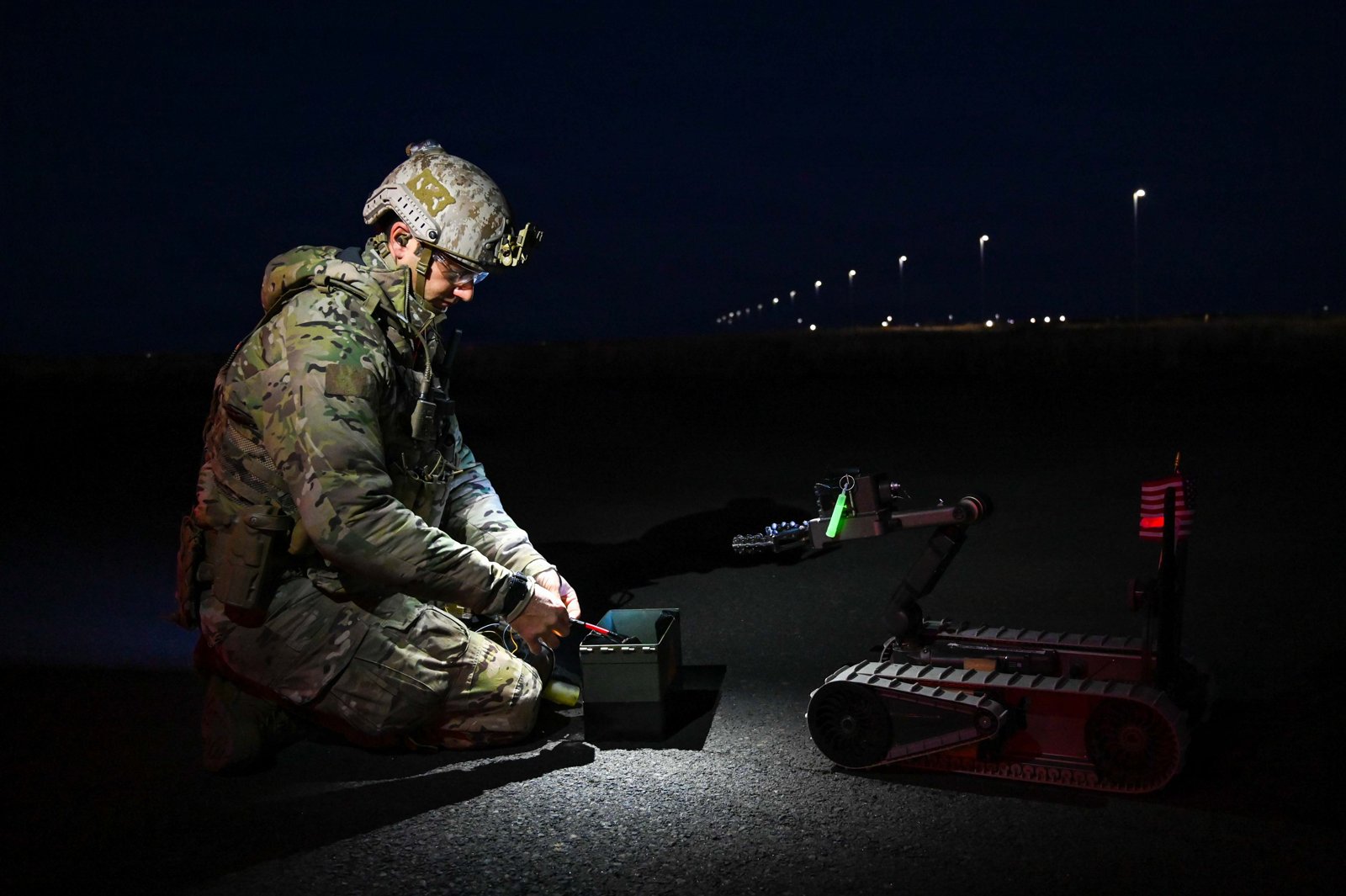
Photo by Petty Officer 1st Class Nicholas Carter, DVIDS. Illustrative image: A U.S. Navy explosive ordnance disposal technician assigned to EOD Mobile Unit 8 prepares an explosive tool for a remotely operated robot during an improvised explosive device drill for Northern Challenge 2026 at Keflavik Air Base, Iceland, on Nov. 11, 2026.
By Ken Wagner
Foundation Future Industries, the robotics company that builds the Phantom MK1 humanoid, says it is not negotiating to supply the Israel Defense Forces, has no contract or other agreement with the IDF or Israel's Ministry of Defense, and has not sold, delivered or deployed any robot to the Israeli military. A company spokesman made that statement in response to claims that the firm was in talks to send as many as 1,000 robots into tunnels under Gaza, the Telegraph reports, in an article read via Yahoo News's full-text republication.
The source of the talks claim is a Financial Times interview with Mike LeBlanc, Foundation's co-founder and president. As the Telegraph relays it, LeBlanc told the Financial Times the company was in direct talks with the chief of staff of the Israel Defense Forces. Everything here about the interview follows the Telegraph's text, not the Financial Times original.
What those contacts amount to is where the two accounts differ. The Telegraph's headline states that the firm is in talks, and its article says Foundation said it was in direct talks with senior Israeli military officials to deploy the Phantom MK1 to patrol Hamas tunnels in Gaza. Per the Telegraph, the spokesman said any conversations mentioned in the report were early and exploratory and did not lead to an agreement, and that Foundation has had no conversations with the IDF in any official capacity.
Beyond the interview, the Telegraph makes two statements without naming a source for them. It says the IDF is expected to purchase up to 1,000 robots from the company, and that if a deal is reached the robots will be sent to patrol Hamas-controlled tunnels beneath Gaza. The article carries no comment from the Israeli military or the Israeli Ministry of Defense.
Phantom MK1 is a humanoid, a robot built in roughly human form. The Telegraph describes it as capable of neutralizing booby traps and detecting trip wires as well as engaging in combat, and puts the cost at around $150,000 per unit. The article does not say whether that figure is a list price, a quoted price or an estimate, and it gives no test results for any of those tasks.
LeBlanc's argument for the machine, as the Telegraph reports it, is about risk to people. He told the Financial Times there was no question of building what he called a Terminator, and said the highest purpose of such robots would be to spare a person from having to kick in a door without knowing whether an armed enemy is waiting on the other side.
On money, LeBlanc said the company had received more than $70 million in contracts from the U.S. military, according to the Telegraph. The article does not identify the contracts or the services that awarded them, and it does not say whether the figure reflects obligated funds or contract ceilings.
Eric Trump, a son of President Donald Trump, holds an equity stake in Foundation and was named its chief strategic adviser in March, the Telegraph reports. It says the company was founded in 2024. A spokesman for Trump told the Financial Times, per the Telegraph, that he has no involvement in Foundation's management, operations, strategic decisions or commercial activities, including the negotiation of government contracts, and has never introduced the company to any government agency.
Neither account describes a program. The company's statement rules out a contract, an agreement, a sale and a delivery. Neither the spokesman nor LeBlanc, as reported, describes a trial with Israeli forces, a stated Israeli requirement or a delivery schedule, and the quantity of 1,000 robots is not attributed to either of them.
Three things would show whether there is anything here beyond a conversation. An on-record statement from the Israel Defense Forces or the Israeli Ministry of Defense would establish whether talks exist in any official form. A contract notice or an announced field trial would be the first evidence of an Israeli requirement for humanoids. On the U.S. side, the contracts behind LeBlanc's $70 million figure, if identified, would show which service is paying and for what work.
Leave a Reply