
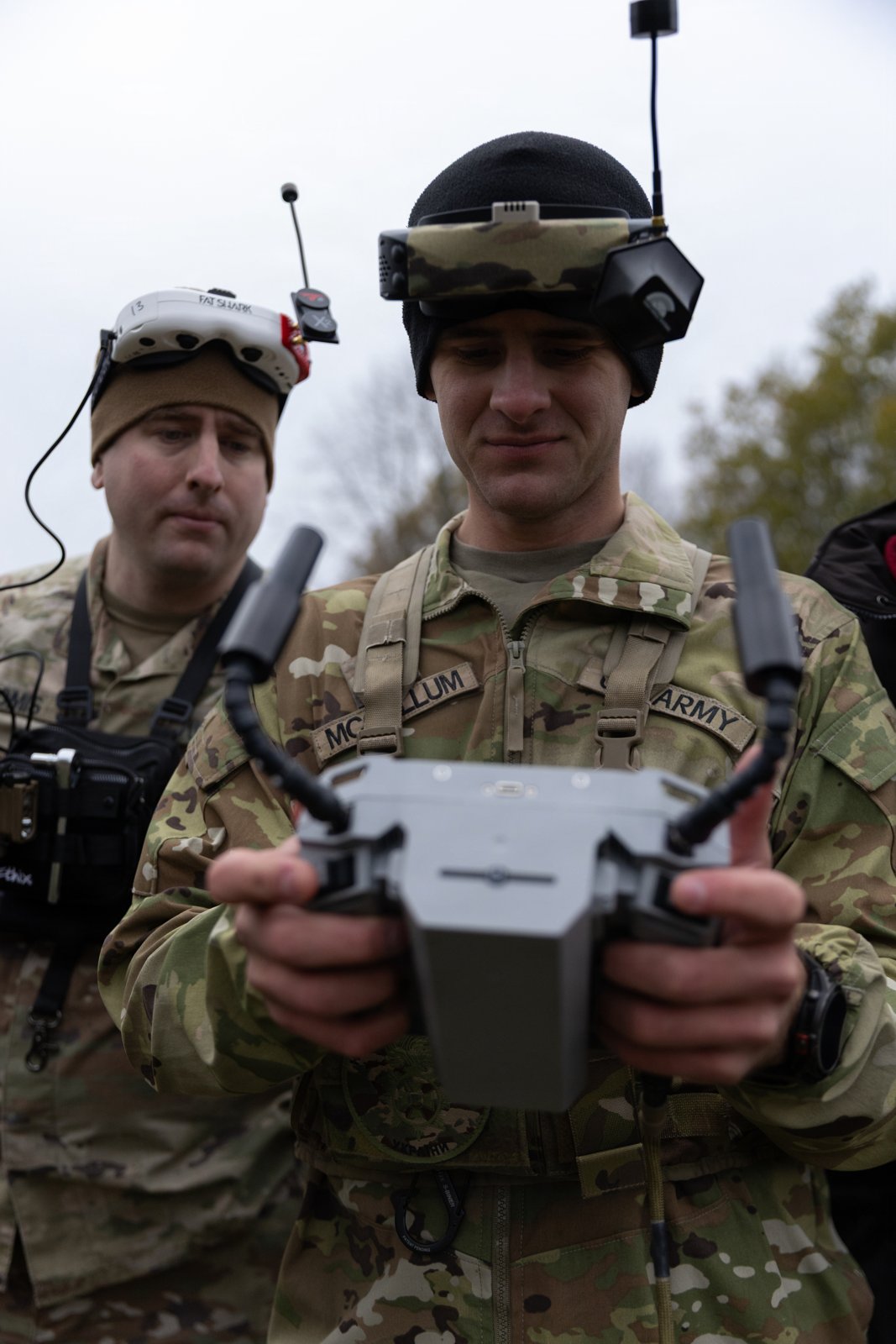
Photo by Sgt. Elijah Campbell, DVIDS. Illustrative image: U.S. Army Spc. Trevor McCallum, a first person view drone operator with the 16th Sustainment Brigade, flies a drone during the first day of Kinetic Reach at the Baumholder Training Area in Baumholder, Germany, Nov. 10, 2026.
By Ken Wagner
Army Brig. Gen. Matt Ross, director of Joint Interagency Task Force 401 (JIATF-401), told a counter-drone forum on Nov. 9 that the task force has asked the Intelligence Community for threat assessments covering both home and abroad. DefenseScoop reports the remarks from the Commercial Drone Alliance's Drone Security Industry and SLTT Grant Forum in Oxon Hill, Maryland. SLTT stands for state, local, tribal and territorial.
"One thing that I haven’t talked a lot about previously is, as an interagency task force, we’ve actually tapped into the entire Intelligence Community," Ross told the audience, according to DefenseScoop.
JIATF-401 is a Pentagon-led team set up in 2025 to synchronize counter-unmanned aircraft system (counter-UAS) initiatives, policies and procurements across the Defense Department and with its interagency partners, the outlet reports.
Ross said the task force is working to "provide greater specificity" when it defines counter-drone needs across military and government organizations. He said it has asked the Intelligence Community for "authoritative assessments of what we should be thinking about" at home and abroad.
Defense, federal and law enforcement officials should determine and describe their own organizations' threats and protection requirements before they field or buy commercial counter-drone equipment from the government's online marketplace, Ross urged, according to DefenseScoop.
"But it’s really easy for us to confuse a sense of vulnerability with a sense of threat," Ross said. He said the first question he asks, and the first he would ask as a recipient of the NOFO, which DefenseScoop spells out as the Notice of Funding Opportunity, is what the threat is and what actually needs protecting.
In Ross's view, as DefenseScoop relays it, that information is what lets counter-drone suppliers build equipment aimed at real and changing threats.
He gave no further details about the partnership with the intelligence agencies, DefenseScoop reports.
Asked afterward, Lt. Col. Adam Scher, JIATF-401's strategic communications advisor, told the outlet the task force has been working closely with the Office of the Director of National Intelligence and the wider Intelligence Community "to continuously assess the battlefield, analyze adversary tactics and employment, and anticipate evolving threats."
"There is no one-size-fits-all solution," Scher told DefenseScoop. "What works in Alaska may not work in Arizona; what is required to protect an Army barracks may differ significantly from the requirements of an airfield or runway."
Scher added that the task force tailors its work to the operating environment, mission requirements and specific threats, and that close collaboration with the Intelligence Community keeps that work informed by the latest intelligence.
Those statements describe a working relationship. DefenseScoop's account names no intelligence agency other than the Office of the Director of National Intelligence. It does not say when any assessment is due, what form it will take, or whether it will be shared with state and local agencies or with the companies that build counter-drone equipment.
On the same panel, officials discussed the new interagency memorandum of understanding (MOU) on testing and deploying counter-drone technology. DefenseScoop reports that the departments of Defense, Transportation, Homeland Security, Energy and Justice signed it and that it applies to their components, including the Federal Aviation Administration (FAA) and the FBI.
Liam McKenna, the FAA's chief strategy officer and acting deputy administrator, said the MOU has not been approved for public dissemination and that its text must be requested through the Freedom of Information Act, according to DefenseScoop.
McKenna said the document covers "the coordination process for reviewing" counter-UAS systems as safety risk assessments are conducted. An interagency "approved technologies list" based on those reviews will eventually follow, he said.
For repeat reviews, the FAA official gave a time. Describing a system the FAA has already looked at for one department and that the Department of Homeland Security then wants to buy, McKenna said: "We’ve seen the system, we can probably approve it and reach an agreement on its use within 24 hours in many cases."
Nothing in the remarks DefenseScoop reports is a purchase, a quantity or a fielding date.
Three things would show whether the intelligence request changes what reaches military units and police departments. One is whether JIATF-401 or the Office of the Director of National Intelligence describes the assessments, even in an unclassified summary. Another is whether the requirements the task force sets for counter-drone equipment become more specific about threats by location and mission, as Ross and Scher say they should. The third is whether the MOU's text is released and the approved technologies list McKenna described appears with named systems on it.
Leave a Reply