
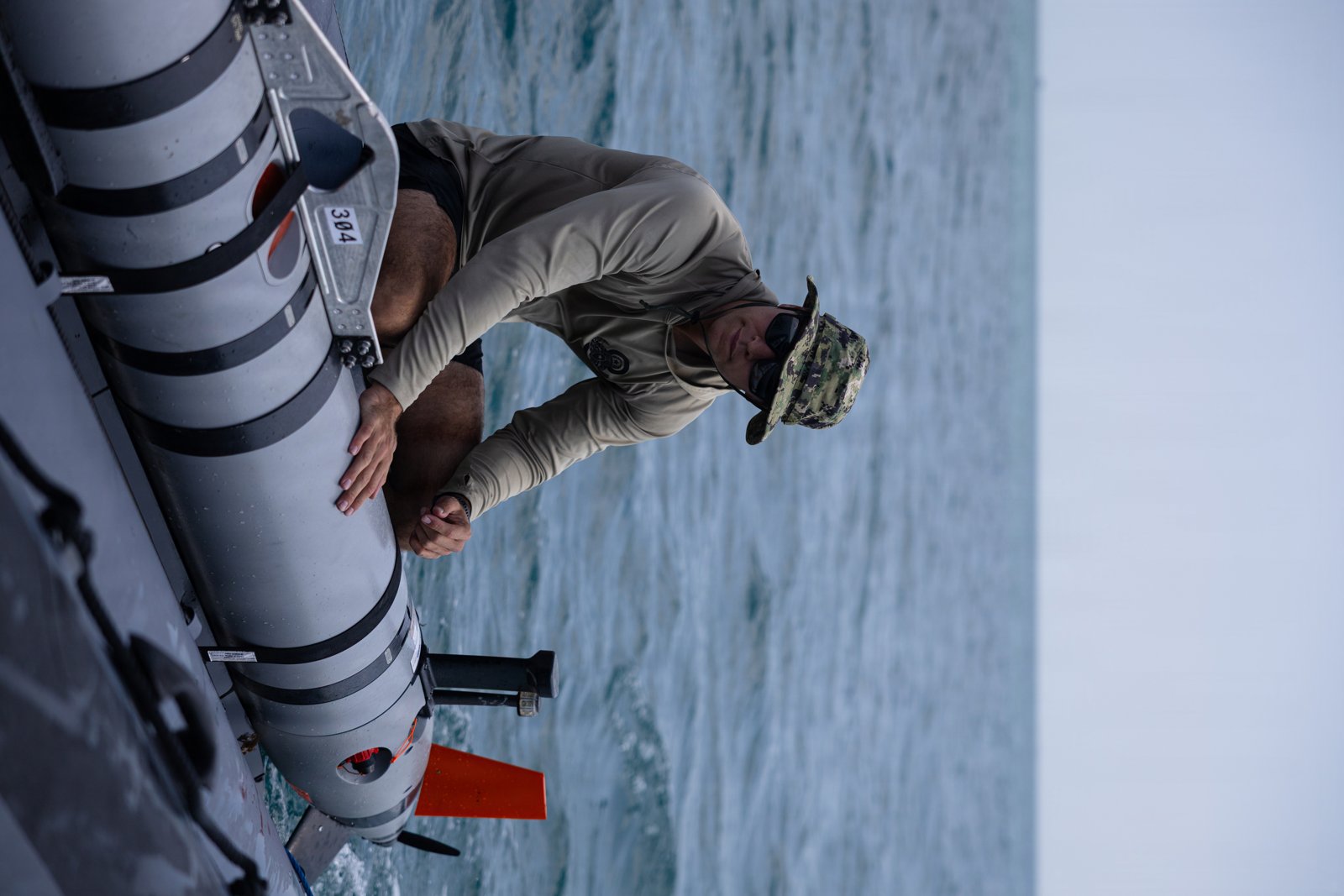
Photo by Petty Officer 2nd Class Jonathan Nye, DVIDS. Illustrative image: U.S. Navy Robotics Warfare Specialist 2nd Class Nathan Britton, assigned to Explosive Ordnance Disposal Mobile Unit 8, recovers and secures a MOD 2 unmanned underwater vehicle during Sea Breeze 26-2 in Portland, England, July 17, 2026.
By Ken Wagner
Two of the Navy's three Orca prototype undersea vehicles have been delivered and the third is expected soon, the officer who manages the program said. Capt. Michael Linn, program manager for the Undersea Warfare Program Management Office, said the service is nearing the end of its production plans for Orca, Breaking Defense reports.
"We’re going to get our third one delivered soon, and that is going to wrap up a long and arduous process of getting Orca over the finish line," Linn said on Friday, according to the outlet.
Orca is an extra-large unmanned undersea vehicle, or XLUUV, built by Boeing. Breaking Defense describes the program as the Navy's first XLUUV initiative, launched in 2017 and aimed at laying undersea mines. Citing Boeing, the outlet says the vehicle has a range of up to 6,500 nautical miles and can carry a variety of mission payloads. Those are the manufacturer's figures as Breaking Defense relays them.
The first test vehicle was delivered in 2023 and the first prototype vehicle in 2025, Breaking Defense reports, citing the Government Accountability Office (GAO).
Delivery of the third vehicle will not end the test work, by Linn's account. He said: "Once we get it in our hands, we’re going to continue to characterize it. We’re going to put it through its paces and figure out what it really does well and what it doesn’t do well. But the point is I’m fully intent on getting it employed and characterized."
Linn also said the Navy will build on what it learned from Orca in the Combat Autonomous Maritime Platform, or CAMP, which Breaking Defense describes as an initiative to quickly prototype and field XLUUVs. In his telling, Orca lays the groundwork for other unmanned undersea vehicle (UUV) programs like CAMP.
A day earlier, a fleet commander spoke about where these vehicles are headed. Rear Adm. Chris Cavanaugh, whom Breaking Defense identifies as the commander of Submarine Forces for the U.S. Pacific Fleet, made a remark the outlet presents as covering Orca, CAMP and Dragonfish. Dragonfish is a large displacement UUV, or LDUUV, that Breaking Defense says replaced the Navy's canceled Snakehead LDUUV program.
"Those are all progressing toward meaningful operational employment," Cavanaugh said Thursday, according to Breaking Defense.
Cavanaugh also described what the unmanned vehicles add to the force. He said: "Those systems complement our crewed platforms, expand our reach, increase our operational flexibility, and allow us to accept risks that we wouldn’t take with manned submarines."
Neither officer gave a delivery date for the third Orca in the remarks Breaking Defense reports. The article does not say when Orca, CAMP or Dragonfish would be assigned to an operational unit, how many CAMP or Dragonfish vehicles the Navy plans to buy, or what any of the three programs costs.
The vehicle count differs between reports. A separate Breaking Defense article on GAO's annual weapon systems assessment says the first Orca prototype was delivered in September 2025 and that four remaining prototypes were expected in January 2027, more than a year later than GAO had reported the year before. Linn's figures, as the outlet now reports them, are two of three prototype vessels delivered and a third on the way. The newer article does not reconcile the two counts.
Four things would show whether Orca moves from prototype to use. The first is delivery of the third vehicle, with a date attached. The second is what the Navy reports from the characterization Linn described, including what the vehicle does not do well. A third would be the assignment of an Orca to a fleet unit or a stated mission. The last is whether CAMP and Dragonfish reach contracts with quantities and delivery dates, which would show how much of the Orca experience carries forward.
Leave a Reply