
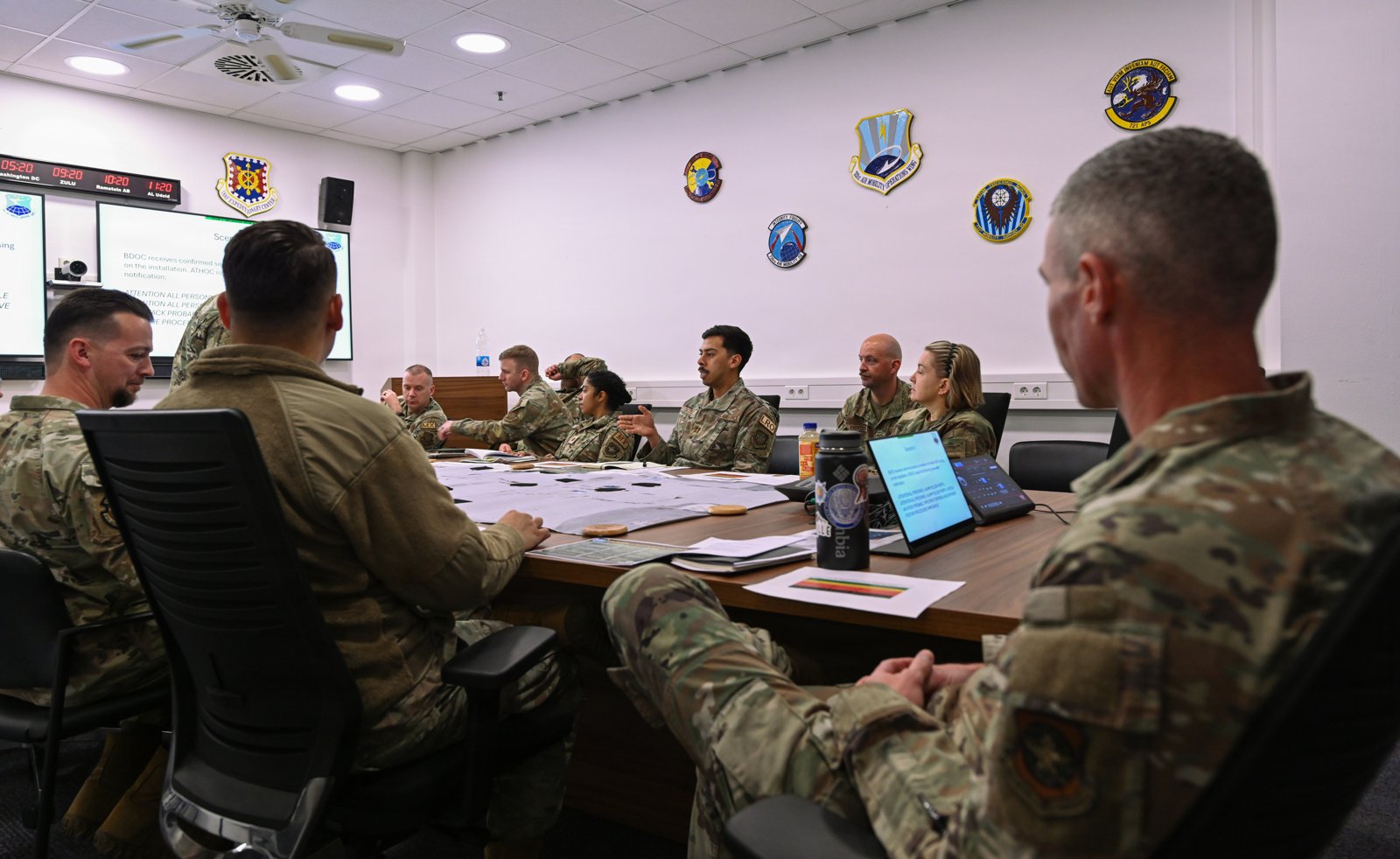
Photo by 1st Lt. George Schroeder, DVIDS. Illustrative image: Representatives from squadrons in the 721st Air Mobility Operations Group take part in an unmanned aircraft systems tabletop exercise at Ramstein Air Base, Germany, Nov. 4, 2026.
By Ken Wagner
Seven industry teams will bring high-energy lasers to Dugway Proving Ground, Utah, in December to fire at live drone targets, and the Army general overseeing the event wants a good showing to lead directly to a purchase order. The Defense Department named the teams in a press release, as reported by DefenseScoop and Inside Defense.
Both outlets carry the same list. Allen Control Systems is entered with Bullfrog HEL, short for high-energy laser, and Aurelius Systems with Archimedes. BlueHalo, which DefenseScoop identifies as an AeroVironment subsidiary, is listed with LOCUST X1. Kord Technologies has Firefly, Thor Dynamics has Laser Armor, and Yrikka has TALOS, described as a drone-based laser. The seventh entry is Crossbow, which Inside Defense lists under Lockheed Martin and IPG and DefenseScoop describes as a system from Lockheed Martin partner IPG Photonics.
Joint Interagency Task Force 401 (JIATF-401) is overseeing the event. DefenseScoop describes it as an Army-led organization that stood up last year to help the U.S. military and its government partners acquire technology to counter unmanned aerial systems, or drones, at home and abroad. The outlet calls the December event phase 2 of a directed energy shoot-off.
The seven were picked from 13 technical white papers. Inside Defense reports that the Defense Department's research and engineering office and JIATF-401 reviewed the submissions. The release did not identify the vendors and systems that were not selected, according to DefenseScoop.
Before any laser fires, the vendors have certification and integration work to finish. Through the rest of November they are to complete required laser safety certifications and integrate with the command-and-control architecture, Inside Defense reports, citing the release. Candidate systems are then due at Dugway for a week of technical safety reviews, communications verification and preliminary range-readiness testing.
Live-fire scenarios are slated to begin by mid-December, according to DefenseScoop. Both accounts of the release say the lasers will engage representative unmanned aerial targets in planned test scenarios, with evaluators assessing how each system tracks and defeats targets above and below the horizon.
Army Brig. Gen. Matt Ross, the director of JIATF-401, tied the test to buying. DefenseScoop reports that Ross said in a statement the task force is trying to structure the shoot-off so that systems that perform effectively can immediately result in a purchase order, one that would let production lines start building lasers for the field.
Ross described that goal to reporters in early October, Inside Defense reports. "We're going to bring them out to Dugway, and then our goal is to structure that shoot-off in such a way that if somebody meets the requirements, it results in immediate contracts, so we can start opening up the production lines to build that breadth and depth in our base," Ross said at the time, according to the outlet. It adds that he cited the event as an opportunity for smaller vendors to enter the military directed energy market.
Emil Michael, the under secretary of defense for research and engineering, said scaled directed energy is one of the department's six critical technology areas and that the department is partnering with industry to deliver a defense with a low cost per shot, according to Inside Defense.
Neither account gives the requirements a laser must meet at Dugway, the number of systems a purchase order would cover, or the money set aside for one.
All seven entries are lasers. DefenseScoop notes that high-energy lasers and high-power microwaves are seen as cost-effective against drone swarms on a cost-per-shot basis, compared with missiles or other projectiles.
The task force named other directed energy systems earlier. It selected AeroVironment's Palletized High-Energy Laser, Epirus' Leonidas high-powered microwave, Kord Technologies' Firefly and Boeing's Compact Laser Weapon for its counter-drone directed energy pilot program, Air & Space Forces Magazine reports, citing a Pentagon announcement. The magazine says those four are to be tested in the December shoot-off at Dugway and that the pilot is a requirement of the 2026 National Defense Authorization Act.
Kord's Firefly appears on both lists. Neither DefenseScoop nor Inside Defense explains how the seven phase 2 teams relate to those four systems.
One laser program already has a production contract. The Army announced in September that it awarded AeroVironment a contract for the Enduring-High Energy Laser (E-HEL) production program, DefenseScoop reports, and the outlet says the Dugway demonstrations will let the military evaluate additional systems for potential procurement.
Three things would show whether the shoot-off produces fielded lasers. The first is whether live fire begins at Dugway by mid-December as scheduled. The second is whether the Defense Department publishes which systems met its requirements, and what those requirements were. The third is a purchase order with a named vendor, a quantity and a dollar figure labeled as an obligation or a ceiling.
Leave a Reply