
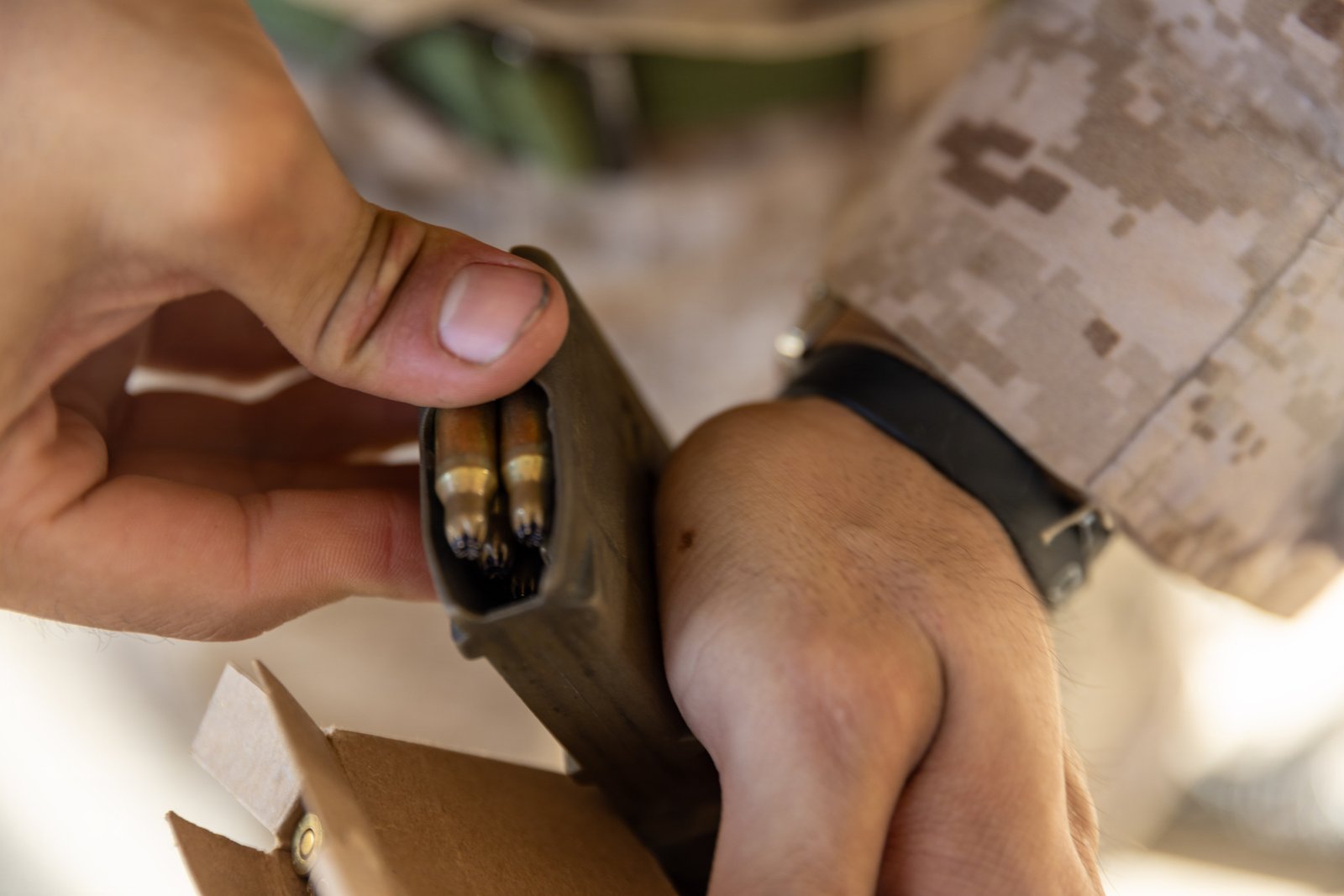
Photo by Staff Sgt. Michael Virtue, DVIDS. Illustrative image: U.S. Marine Corps Lance Cpl. Allen Apodaca of Battalion Landing Team 2/4, 13th Marine Expeditionary Unit, loads blank 5.56mm ammunition into a magazine during training in Okinawa, Japan, on Nov. 13, 2026.
By Steven Smith
LeoLabs has acquired FishEye Software, an engineering services company that works on government radars for missile defense and space domain awareness, and will operate it as a wholly owned subsidiary. The buyer did not disclose a price.
The company's announcement, datelined Menlo Park, California, and Maynard, Massachusetts, Nov. 16, 2026, states the purpose in one sentence. FishEye "will strengthen LeoLabs’ ability to accelerate delivery of its next-generation radars optimized for missile warning and tracking."
One of those radars is Scout-X, a LeoLabs spokesperson told Breaking Defense. A LeoLabs release datelined Nov. 5, 2026, lists Scout-X as the company's radar optimized for missile warning and tracking, next to its Scout-S, Seeker and Ranger radars.
FishEye is described in the announcement as "an engineering services company specializing in mission-critical U.S. Government defense systems." It has nearly 30 years of experience in systems engineering, software development and field testing for radars the government owns and operates, the announcement says.
Breaking Defense reports that FishEye was founded in 1997, is headquartered in Massachusetts and was one of several thousand small firms chosen last December for the Missile Defense Agency's Scalable Homeland Innovative Enterprise Layered Defense contract vehicle, known as SHIELD. The outlet describes that vehicle as worth up to $151 billion through 2035.
That figure is the upper limit for the whole vehicle, shared among all of its awardees. It is not an amount awarded to FishEye, and the Breaking Defense report gives no figure for work FishEye has received under it.
On how the purchase was paid for, the announcement offers one line. "LeoLabs funded the transaction with proceeds from a loan provided by Hercules Capital, Inc." It does not state the size or terms of that loan. Mirus Capital Advisors served as exclusive financial advisor to FishEye, according to the same text.
"FishEye brings decades of experience developing and integrating software for U.S. missile defense systems," Tony Frazier, chief executive officer of LeoLabs, says in the announcement. "That expertise will help us continue to adapt our proven radar technology for missile warning and tracking, and move those capabilities into operational use quickly."
Bob Chisholm, president of FishEye, is quoted alongside him. "Joining LeoLabs gives our team the opportunity to apply its deep mission knowledge to a new generation of radar systems and deliver these capabilities directly to the warfighter," Chisholm says.
Two earlier LeoLabs announcements supply the financial backdrop, and the acquisition announcement cites both. The first is a bookings figure. LeoLabs says it "recently reported more than $100 million in bookings for 2026 across U.S. and Allied customers." That is a number the company reports for itself, and its release on the subject, datelined Oct. 29, 2026, names no customers or contracts behind it.
Federal financing is the second. LeoLabs "secured a $150 million conditional loan commitment from the U.S. Department of War’s Office of Strategic Capital" to speed deployment of radar infrastructure, the acquisition announcement says. The Nov. 5 release words it as "up to a $150 million conditional loan commitment" from that office.
Both documents describe a loan commitment that is conditional. Neither states the conditions or says whether any of the money has been drawn.
According to the Nov. 5 release, the financing is meant to expand U.S. radar manufacturing, including "the completion of two large-scale manufacturing facilities by 2028" and the addition of dozens of radars to the company's global network by 2030. The Oct. 29 release says Seeker and Scout radars are already moving through a U.S. manufacturing line for delivery in 2027, and that the company plans to nearly double its employee base by the end of 2026.
Several facts are absent from the acquisition announcement. It names no government program, contract or customer for the missile warning radars. It gives no headcount for FishEye and no date by which a Scout-X would reach a government user.
Three steps would show whether the purchase turns into fielded radars. The Office of Strategic Capital financing would have to move from a conditional commitment to a closed loan. The Seeker and Scout deliveries LeoLabs has scheduled for 2027 would have to take place. And an order under SHIELD, or another government award naming LeoLabs or FishEye for missile warning and tracking work, would show a customer behind the radars the acquisition is meant to speed.
Leave a Reply