
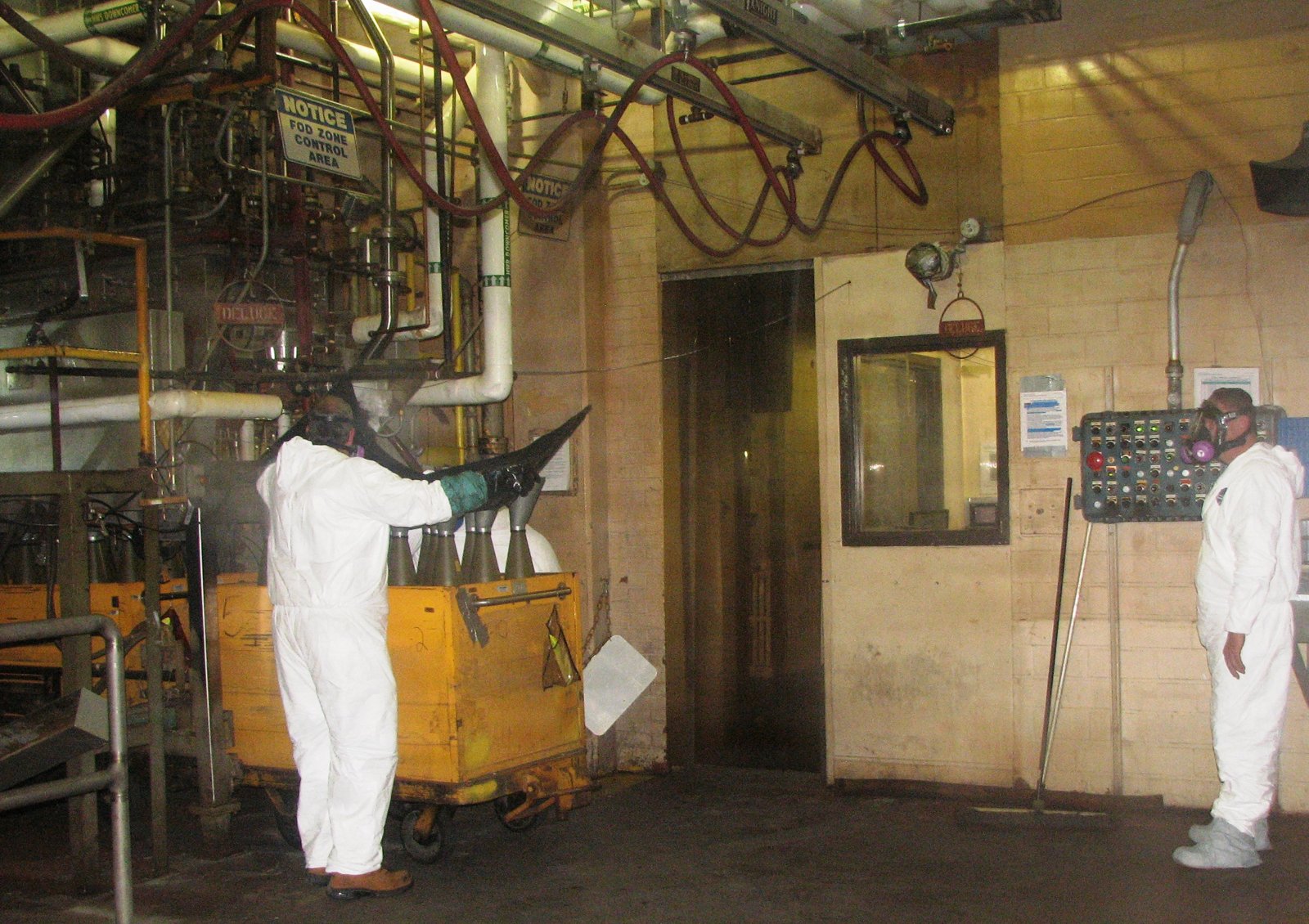
Photo by Dori Whipple, DVIDS. Illustrative image: Contract employees at Iowa Army Ammunition Plant prepare 155MM/M795 projectile cases for the final steps in the load, assemble, pack process for ammunition production.
By Steven Smith
The Army will destroy degraded lead azide stored at the Iowa Army Ammunition Plant in Middletown by detonating it in place at around noon on Friday, Nov. 20, Tri States Public Radio reports in a story carried by NPR Illinois. Plant modeling described in that report predicts lead particles could be carried through the air over an area up to 20 miles wide.
Two detonations are planned, according to KWQC. Lead azide is an explosive used in the detonation of ammunition, and the material at Middletown has been stored there for roughly 20 years, WQAD reports in a story read via Yahoo News, which republished it in full. An inspection earlier this year found it had deteriorated, and Army officials said moving the barrels could cause an uncontrolled detonation, WQAD reports.
Plant officials say the blast will create an air plume, according to Tri States Public Radio. The modeling predicts the possibility of elevated levels of lead particles in the air in an area up to 20 miles wide, stretching from Burlington to well north of the Quad Cities. Some particles could settle on the ground in an area up to 10 miles wide, from near Burlington to north of Wapello and New Boston.
Those maps are not final. Tri States Public Radio reports the Army will update them 48 hours before the detonation, again six hours before, and then every hour until the shot. A final estimate of the affected areas is to follow once the detonation is complete.
On timing, the accounts differ slightly. Tri States Public Radio gives around noon. WQAD reports that Army officials put the detonation at some point between 11 a.m. and noon, with short siren blasts five minutes beforehand and a sustained blast at one minute. An initial all-clear should come between 1:30 and 2 p.m., weather and schedule permitting, WQAD reports.
Residents of the Middletown City Park neighborhood are being told to be out of their homes from 8 a.m. to 2 p.m. WQAD describes that as an Army recommendation. KWQC describes it as an evacuation the detonation will require, and attributes the reason to the Army: ground vibrations could break windows.
For people inside the mapped areas, the Army's guidance as relayed by Tri States Public Radio is to stay indoors, keep windows and doors closed, set heating and cooling systems to recirculate where that is safe, and avoid unnecessary travel through affected areas.
KWQC interviewed Justine Barati, whom it identifies as an Army public affairs specialist, about how the Army intends to hold the lead near the site. Crews are wetting the soil and using a water mist, she told the station.
“So when the detonation occurs, the majority of lead, since lead is a heavy metal, will stay in that location and kind of bind to the concrete,” Barati said.
She also described the monitoring standard. “Since the EPA says there’s no safe level of lead, we’re looking at every level to the tiniest microgram,” Barati said, referring to the Environmental Protection Agency.
KWQC also sought an outside view. Patrick O’Shaughnessy, a University of Iowa professor whom KWQC describes as an expert in environmental health, told the station in a separate report that the main risk is a lead-carrying plume.
“It’s completely unprecedented as far as I know,” O’Shaughnessy said. He urged anyone near Middletown to be south of the explosion, KWQC reports.
Property owners whose buildings are damaged can file a claim with the Army on a Standard Form 95 and have two years from the date of the damage to do so, according to KWQC. Residents can also volunteer to have their soil tested after the blast. Some school districts around Middletown are canceling classes on the day, WQAD reports.
The quantity involved comes from earlier reporting. Business Insider has reported, citing Barati, that 68 barrels of lead azide sit in two earth-covered magazines and that the material was no longer needed for production.
For the munitions production base, the open question is the plant itself. KWQC reported in a March story that the plant paused operations on March 12 for a safety review to plan the lead azide's removal, with no estimate for when operations would resume. Business Insider describes the Iowa plant as a critical production facility for medium- and large-caliber munitions and says the Army expected a four-hour delay to construction of its new 155mm line on the day of the detonation. The current local reports do not say whether production has resumed or whether that four-hour estimate still stands.
What to watch next starts with the map updates due 48 hours and six hours before the shot, which would show whether the forecast exposure area has moved. After the detonation, the Army's final estimate of the affected areas and its soil sampling results would show how far the lead traveled. Beyond that, the items still unreported are the number and size of damage claims, and an Army statement on when the Iowa plant returns to full production.
Leave a Reply