
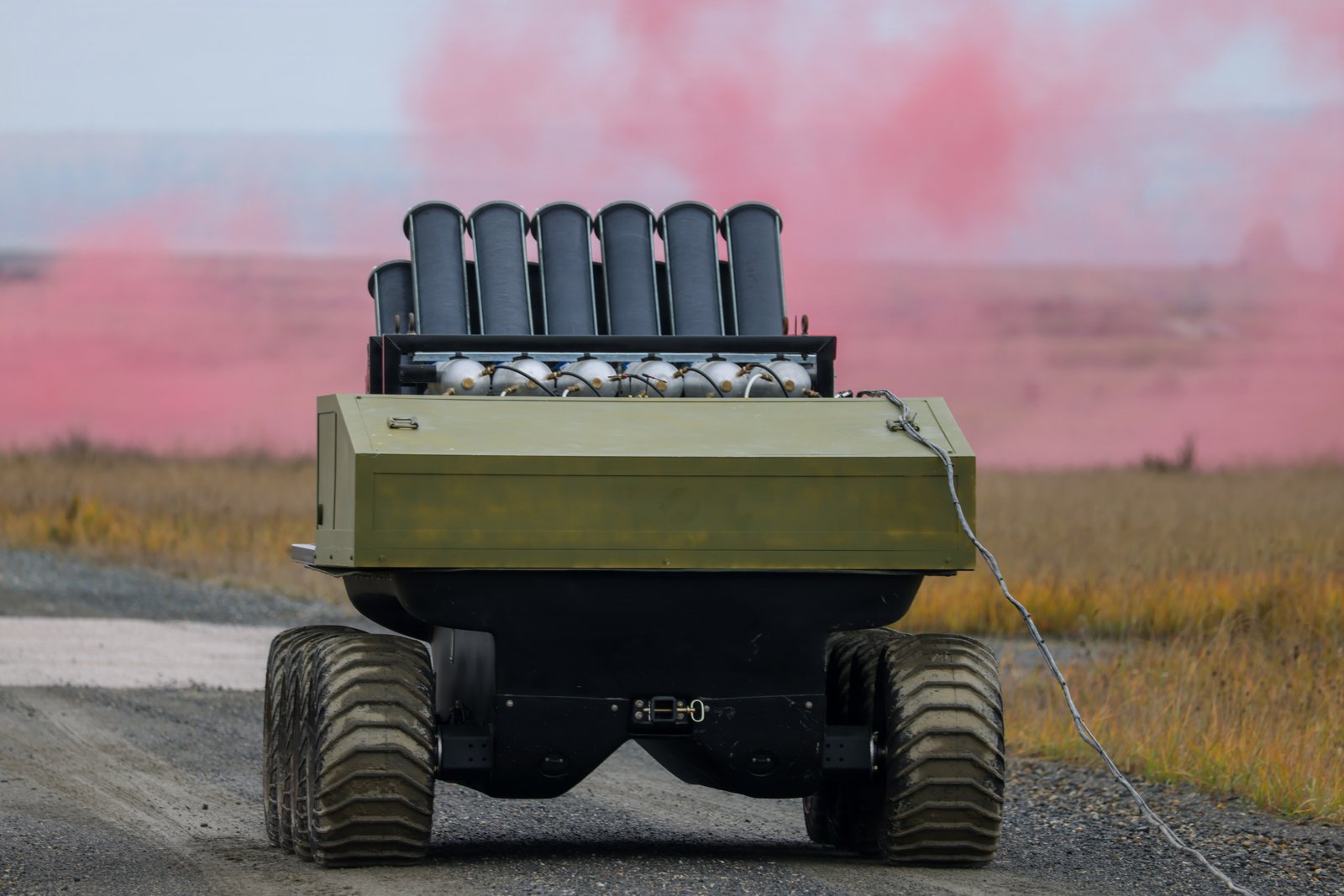
Photo by Cpl. Thomas Dixon, DVIDS. Illustrative image: A R3NEGADE unmanned ground vehicle fitted with a HIV3 swarm drone launcher from the U.S. Army Combat Capabilities Development Command Armaments Center prepares to launch drones during a live-fire technology demonstration at Grafenwoehr Training Area, Germany, Nov. 12, 2026.
By Ken Wagner
Most of the counter-drone systems the Department of Homeland Security (DHS) evaluated at its Kinetic IV test event in Oklahoma were interceptors built to hit their targets, the department's under secretary for science and technology tells the Washington Examiner.
“The bulk of these were devices that will accelerate and impact the UAS system,” Pedro Allende told the Examiner's Pentagon Posture, using the abbreviation for unmanned aircraft system. He went on: “So direct kinetic impact. There were a couple of net-based interceptors. So fly behind or around, deploy a net, capture, and bring it down to the ground safely.”
DHS's Science and Technology Directorate (S&T) ran a two-week demonstration and evaluation from Nov. 3 to 13, 2026, at the Choctaw Nation of Oklahoma Emerging Aviation Technology Center in Stringtown, according to a DHS news release. The release calls it the fourth consecutive year of the test series and the first held at the Choctaw Nation site, which it describes as a testbed for unmanned aircraft designated by the Federal Aviation Administration (FAA).
Eleven commercial vendors took part. DHS says technical experts from government, industry and international partners evaluated them on metrics that included system effectiveness, reliability, operational suitability, setup time, ease of deployment and collateral effects.
By the department's account, the approaches under test included kinetic interceptors designed to collide with or capture targets, entanglement systems that deploy nets, and directed-energy weapons that disable a drone's electronics. DHS says the directed-energy weapons can be used against single drones or multi-drone swarms. The department groups all of them under counter-unmanned aircraft systems, or C-UAS.
Several things a buyer or operator would need are not in the release. It does not name the 11 vendors, report any results, or say how many systems of each type were tested. Allende's description to the Examiner is the only breakdown either source gives, and it is not a count.
According to the Examiner, DHS relies heavily on electronic mitigation for counter-drone defense, “but being able to kinetically mitigate is a tool that we would like to bring to the arsenal in the event that the other more conventional approaches are not meeting the mail on a particular scenario,” Allende said.
He separated the homeland mission from the military one. “I think you know the domestic use and the use to protect the forward operating base is pretty different,” Allende said.
For events that carry a Special Event Assessment Rating, which the Examiner describes as the risk rating DHS assigns to large gatherings, Allende said it is important to bring a threat down in a way that limits the effect on people below. He added: “The collateral damage is something we want to minimize, mitigate, and frankly eliminate.”
The release also carries the FAA's position. “Testing like this is critical because it allows the FAA and our federal partners to evaluate counter-drone technologies in a real-world environment, understand how they operate and identify potential impacts to the National Airspace System before deployment,” Acting FAA Deputy Administrator Liam McKenna said in the DHS statement.
Allende also gave the Examiner figures from this summer's World Cup. DHS brought down about 2,000 drones and confiscated 700 during the tournament, he said. The article does not say what methods were used.
“Obviously, we’re not in a position to protect every event,” Allende said. Some private-sector entities are starting to take on drone protection of their own accord, in coordination with DHS teams, he told the outlet.
Homeland Security Secretary Markwayne Mullin observed a demonstration at the site on Nov. 12, according to a DHS photo caption published with the Examiner article. The DHS release says Mullin championed the testbed while serving in the U.S. Senate.
On what follows, DHS says only that the data gathered “will inform federal procurement strategies” for its operational components. The release names no program, quantity, budget or schedule, and no dollar figure appears in either source. Nor does it identify any system the department has bought as a result of the three earlier events in the series.
What to watch is whether Kinetic IV produces anything an operator can use. A published set of results or a list of the vendors from S&T would be the first step. A solicitation or an order from a DHS component for a kinetic or net-based interceptor would be the second. The Examiner reports that attention has already moved to the 2028 Summer Olympics in Los Angeles, and whether any system tested at Stringtown is in service by then would show what four years of testing have delivered.
Leave a Reply