
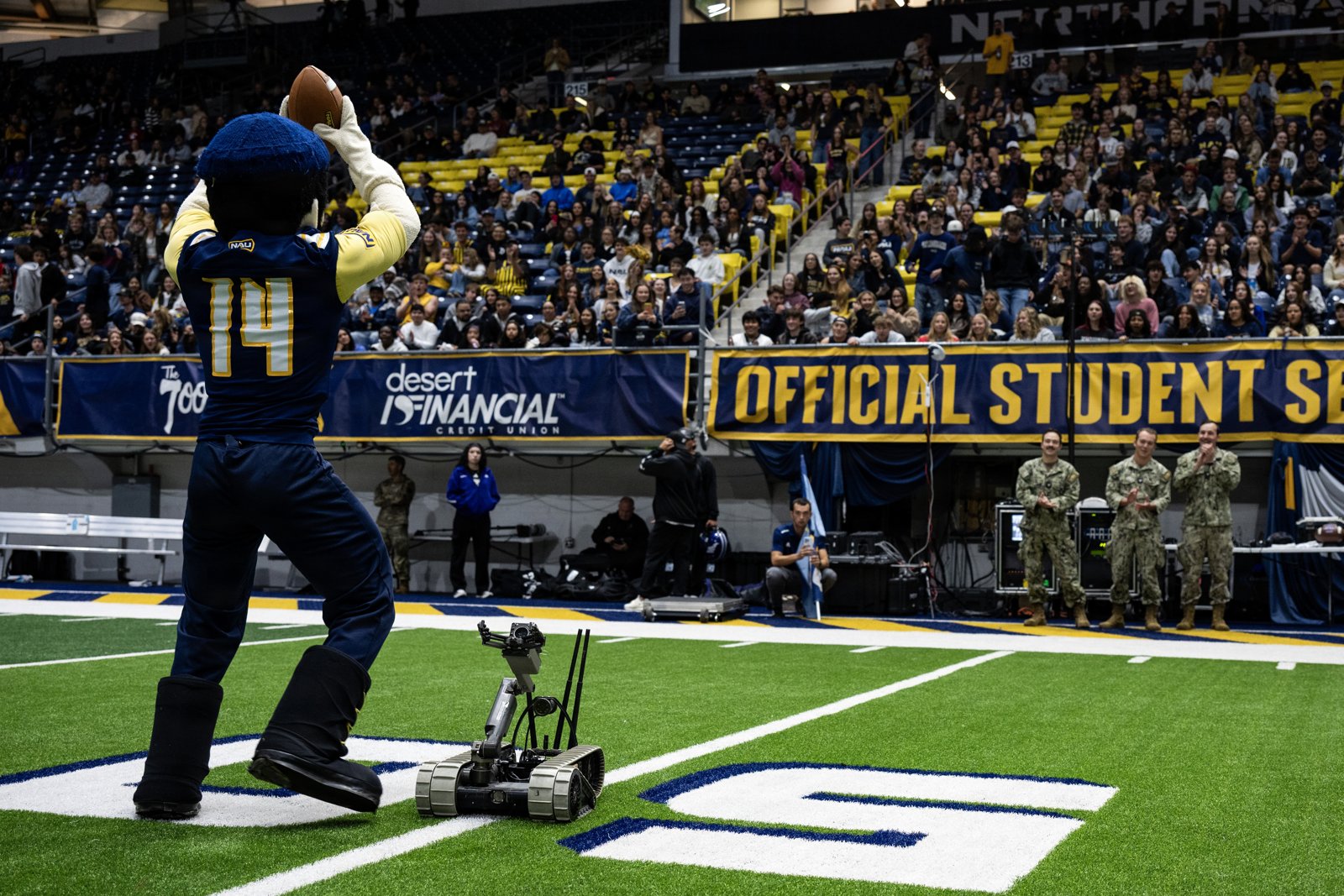
Photo by Petty Officer 1st Class Charles J Scudella III, DVIDS. Illustrative image: An unmanned robot controlled by an explosive ordnance technician delivers the game ball before a football game at Northern Arizona University during Flagstaff Navy Week in Flagstaff, Ariz., Nov. 14, 2026.
By Ken Wagner
A regiment of China's People's Liberation Army (PLA) ground force has put what it calls an intelligent artillery calibration robot into live-fire training at high altitude, the military's newspaper PLA Daily reports. In one exercise on a plateau range above 5,000 meters, the Chinese-language report says, a newly appointed gun commander used the device and four rounds hit their target.
Global Times, a Chinese state-run newspaper, carries an English summary of the report. Both accounts come from Chinese state media, and neither gives a measured before-and-after comparison.
According to PLA Daily, the gun commander used the robot to pull altitude, temperature and wind-speed data in real time, and its built-in algorithms calculated and automatically corrected the firing data. The developer is Zhang Guozhu, whom Global Times identifies as a master sergeant second class in the regiment. Zhang told the paper the system can inspect a gun automatically under different climate and altitude conditions, build a baseline database for each gun and produce an inspection report.
PLA Daily's reporters describe the robot as a plain-looking metal unit sitting on a stand in the regiment's innovation workshop, with a data terminal at the firing position. Nothing in the report describes it moving under its own power or physically handling the gun.
The paper traces the project to a failed shoot. Several years ago, after a new type of artillery piece reached the regiment, a plateau live-fire exercise produced large firing deviations and accuracy below what the report calls combat requirements. The unit's analysis blamed inexperienced gunners and too little calibration preparation under time pressure.
Zhang, who has worked on guns for more than 20 years, first built a gun-sight calibration system for one type of self-propelled artillery from equipment already issued to the unit. PLA Daily says he spent 28 consecutive days entering more than 3,000 sets of field data from extreme cold, high wind and high altitude, that the work took more than 100 days, and that the system received a national invention patent.
That first system still depended on several separately issued devices and took a long time to run, according to the report. Zhang used leave to visit the equipment's manufacturer, where an industrial AI vision inspection setup caught his attention, and spent more than a year rebuilding the software and hardware with guidance from a military academy instructor.
In July 2025, he and the manufacturer's researchers produced the current robot, the paper says. Zhang writes in a first-person note published with the report that the effort took more than four years in all.
Every performance claim in the report is qualitative. Zhang says firing preparation time is much shorter and accuracy much higher. One sergeant says new gun commanders can now shoot at the level of experienced ones even in extreme weather, and a senior sergeant says crews spend less effort on calibration and more on tactics and fire coordination. Troops nicknamed the device the "robot squad leader" in Global Times' English rendering.
PLA Daily gives no calibration times, no miss distances and no count of guns or batteries equipped. It does not name the regiment, the gun or the manufacturer. Its only firing result is the four rounds in the opening exercise.
For outside comment, Global Times turns to Song Zhongping, whom it describes as a military affairs expert. Song told the outlet that thinner air, temperature gradients between air layers and a shortage of flat ground for calibration all make plateau gunnery harder. He said he expects the robot's accuracy, reliability and safety to improve as its database grows, and the article attributes no test data to him.
On fielding, PLA Daily says only that the robot is now in use in the regiment's training. The report does not say whether the PLA ground force has adopted the device beyond that regiment, whether the manufacturer is building more, or what one costs.
What to watch is whether the device appears outside this regiment. A named unit or gun type, calibration times measured before and after, or a procurement notice or exhibition display from the manufacturer would each show more than the current report does. Coverage of other plateau artillery units training with the same device would indicate wider adoption.
Leave a Reply