
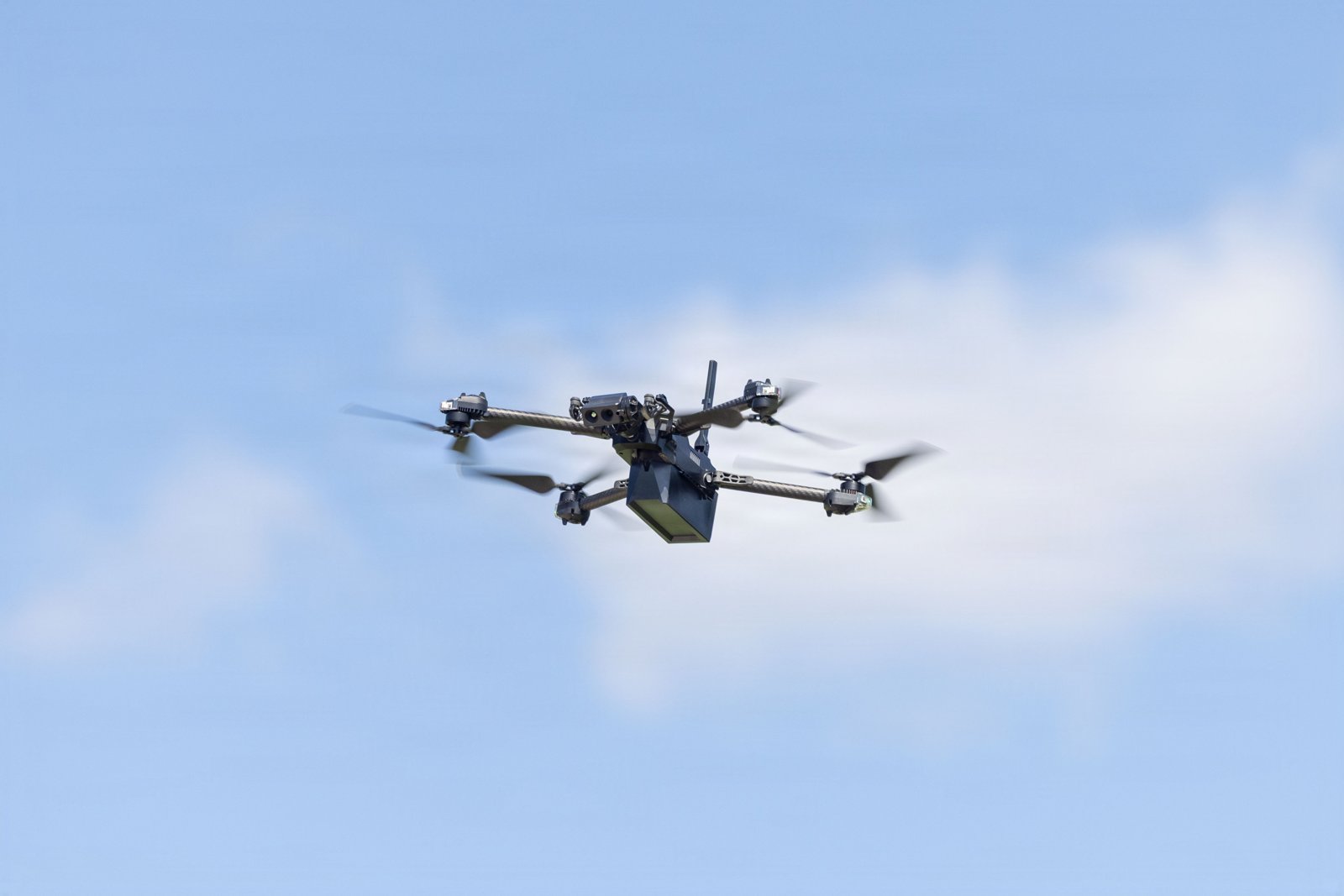
Photo by Cpl. Salvador Flores Perez, DVIDS. Illustrative image: A Skydio X2D quadcopter drone is flown during small unmanned aircraft systems training at Marine Corps Base Camp Lejeune, North Carolina, Sept. 15, 2026.
By Ken Wagner
KNDS Deutschland says it is showing a prototype counter-drone vehicle called FENNEK AIR for the first time at the NIDV Exhibition Defence & Security (NEDS) in Rotterdam, pairing a 30 mm cannon with software meant to help the crew find and engage drones. The company describes the vehicle in a press release. Unmanned Airspace reports that the show takes place on Nov. 19.
AIR stands for Artificial Intelligence Revolvergun, according to KNDS. The vehicle is built on the FENNEK, which the release says was originally designed for reconnaissance and observation. KNDS calls the new version a counter-unmanned systems vehicle and presents it as one part of a multi-layered drone defense.
The gun is the plainest part of the description. For what the release calls the effector, the prototype carries the ARX30 Remote Controlled Weapon System from KNDS France and its 30 mm automatic cannon, which takes 30×113 mm ammunition and is described as dedicated to counter-drone missions. The release gives no rate of fire, engagement range or ammunition load.
Software is where the company makes its larger claims. A core element of FENNEK AIR will be a fully integrated artificial intelligence (AI), KNDS says. Depending on the level of AI support the crew selects, the software processes data from the vehicle's sensors in real time, then detects, targets and eventually engages drones.
By the company's account, that processing cuts the sensor-to-shooter loop, the time between a sensor picking up a target and a weapon firing at it, to “mere seconds” and leaves crews with a smaller workload and faster decisions when they face drone swarms.
The release puts no measurement behind that claim. It gives no engagement time, no number of drones handled at once and no test event, and it does not say the prototype has fired at a drone. Nor does it identify the sensors feeding the software.
How much the machine decides is also left open. The body of the release describes levels of AI support chosen by the crew. A photo caption in the same release says the vehicle “features a fully integrated AI for autonomous operation.” The document does not say whether a crew member must approve each engagement at the highest level of support.
The AI also continuously adapts to changing drone threats using the data it processes, KNDS adds, and it can exchange data across all FENNEK AIR vehicles through what the company calls meshed intelligence. The software is a closed system, the release says, so customers retain full sovereignty over it.
“Protecting critical infrastructure against drone attacks has become a key concern for national security,” said Frank Schnur, senior vice president of the company's Division Wheeled Armored Vehicles, in the release.
He added: “With FENNEK AIR, we’re working on equipping a proven platform with a powerful AI algorithm that potentially outpaces the speed at which new drones are developed.”
Schnur's phrasing matches the rest of the document, which calls the vehicle a prototype and says the AI will be a core element of it.
The prototype also carries what KNDS calls a new kind of adaptive camouflage, connected to both the AI and the weapon station. According to the release, it can change the vehicle's outline so that it appears to be a different type of vehicle, and it can blend the vehicle into its surroundings so that it is harder to detect. The company does not explain how the camouflage works.
For units, the most practical line comes near the end of the release. KNDS says the AIR mission kit, which it labels a counter-unmanned aircraft system (C-UAS) kit, can be integrated into existing FENNEK fleets and into other systems. That would make FENNEK AIR an upgrade for vehicles already in service as well as a new vehicle, if a customer orders it.
None has been announced. The release names no customer, no order, no price for the kit or the vehicle, and no production or delivery date. It does not name a current FENNEK operator.
Two arms of the group appear in the one product: KNDS Deutschland is presenting the vehicle and KNDS France supplies the weapon station. The release describes KNDS as born from the alliance of Nexter and Krauss-Maffei Wegmann and as a land defense company with nearly 11,000 employees.
What to watch next is evidence that moves the vehicle past the exhibition floor. A live-fire trial against drones, with engagement times published by KNDS or a customer, would test the “mere seconds” figure. A named customer for new vehicles or for kits fitted to an existing FENNEK fleet, with a quantity and a delivery date, would show whether the mission kit reaches units. A statement of what the crew must authorize at each level of AI support would answer the question the caption raises.
Leave a Reply