
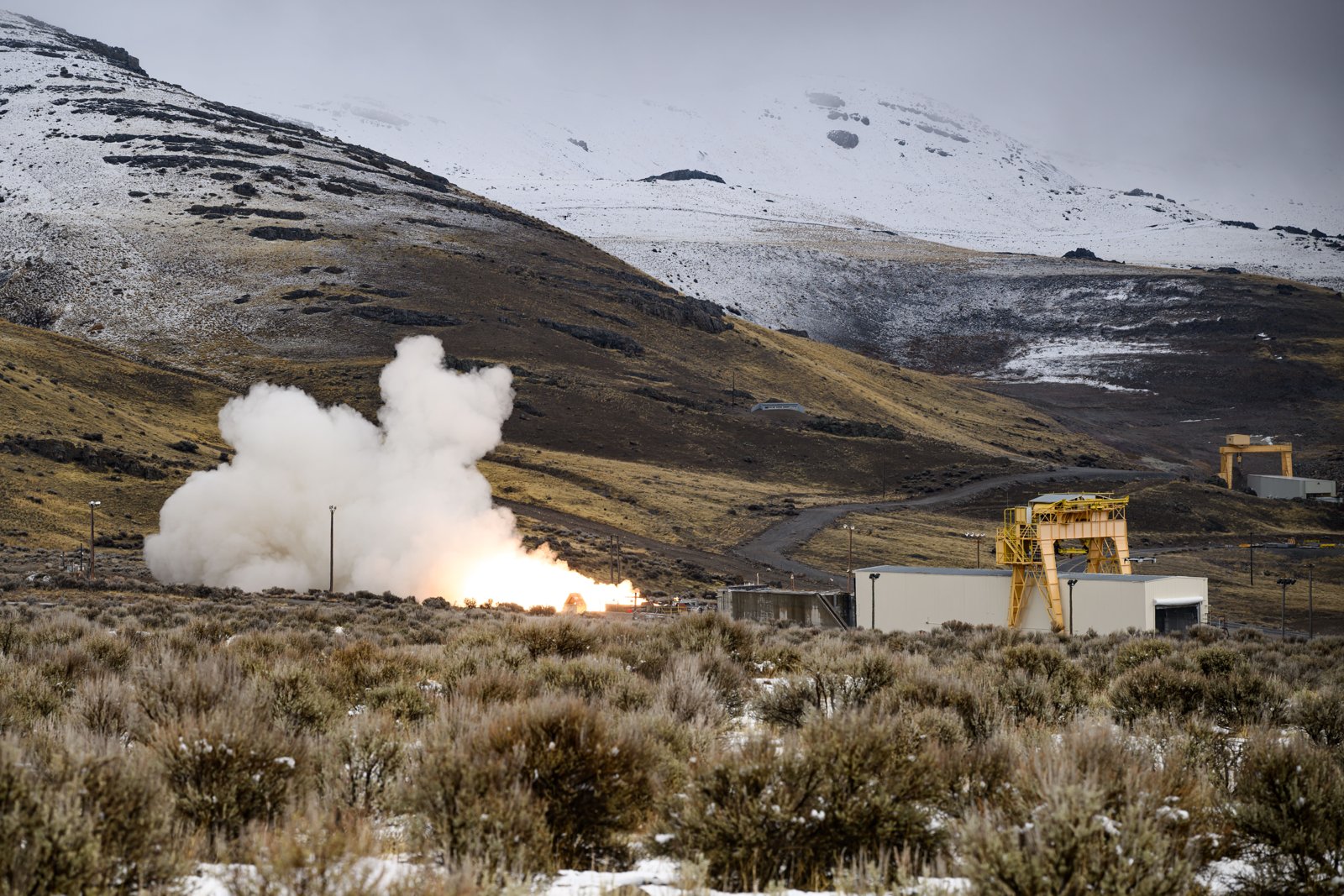
Photo by Ronald Bradshaw, DVIDS. Illustrative image: The U.S. Air Force and Northrop Grumman conduct a full-scale qualification static fire test of the Sentinel intercontinental ballistic missile stage-one solid rocket motor at Northrop Grumman’s facility in Promontory, Utah, March 6, 2025.
By Steven Smith
Raytheon, an RTX business, has awarded Ursa Major and Avio USA a joint contract to design, develop and qualify a new solid rocket motor booster for the Navy's Tomahawk cruise missile, the two suppliers say in a joint release. They disclose no contract value, contract type or schedule.
The contract covers development and qualification, not production. The award “creates a pathway for both companies to become qualified U.S. suppliers for the program,” the release says, and the companies intend to qualify the jointly designed booster and demonstrate eligibility for future production orders. No production order, quantity or delivery date is announced.
By the companies' own description, orders to build boosters would follow qualification, and the release sets no date for either step.
On the buyer's side, the stated purpose is a second line of supply. “Expanding the industrial base for Tomahawk propulsion is essential to ensuring this critical capability remains ready for the fleet,” said Sam Deneke, president of Naval Power at Raytheon, in the release. Deneke described the move as dual-sourcing the component with both Avio USA and Ursa Major, and said it builds the capacity needed to meet the Navy's requirements.
Missing from the release is the name of the company that supplies the Tomahawk booster today. It also does not say how Raytheon would divide future orders between that supplier and the new team, or between Ursa Major and Avio USA.
Breaking Defense describes the selection as adding a second supply source for the motor. In its account, a solid rocket motor powers the Tomahawk in the initial stages of flight and is then jettisoned, and a turbofan engine carries the missile to its target.
Each partner is assigned a role in general terms. The release calls the two companies strategic partners on a multi-year program and says Avio contributes its heritage in solid rocket propulsion, manufacturing expertise and investment in U.S. production, while Ursa Major contributes its design approach and manufacturing processes. Which company would build which part of the booster, and at which site, is not stated.
“Tomahawk is a critical capability for the warfighter, and meeting growing demand requires more capacity and a stronger, more resilient supply chain,” said Jason Meredith, president of Ursa Major.
Where the motors would be made is not settled in the release. Ursa Major is headquartered in Berthoud, Colorado, and has manufacturing operations in Youngstown, Ohio, according to the release. Avio USA, the Arlington, Virginia, subsidiary of Italy's Avio S.p.A., broke ground in September on a solid rocket motor manufacturing facility in southern Virginia.
James Syring, Avio USA's chief executive, said in the release that the award “marks a significant step forward for our planned U.S. manufacturing facility,” and the release gives no date for that plant to begin production. Avio USA's website says the company is building the facility and lists an October cooperation agreement with Lockheed Martin on solid rocket motor production among its announcements.
The booster award follows a production contract for the missile itself. In August the Navy awarded Raytheon a $22.9 billion contract to raise Tomahawk production to 1,000 rounds a year, Breaking Defense reported at the time. That report does not say whether the $22.9 billion is a ceiling or money obligated at award, and it says RTX gave no specific timeline for the increase.
In the new release, the booster work is tied to that demand only in general language. It says that by establishing qualified domestic suppliers Raytheon will expand competition and production flexibility, strengthen supply chain resilience and help meet growing military demand for munitions. It gives no number of boosters and no annual rate, so the documents do not show when a second booster source would begin contributing to the 1,000-round target.
Funding is a separate question. Breaking Defense reports that the Pentagon's munitions production plans still have to clear a funding hurdle in Congress, and that Senate appropriators have proposed a budget that would fund programs like Tomahawk.
What to watch next starts with the terms. A disclosed value and contract type from Raytheon, Ursa Major or Avio USA would show how much development the award buys. Test milestones for the jointly designed booster, and a stated qualification date, would show whether the pathway in the release has a schedule. The step that would turn the announcement into capacity is a production order from Raytheon to either company, and the state of Avio USA's Virginia plant when that order comes would show where the motors can be built.
Leave a Reply